CDU: The Hydraulic Frontier That Decides Whether Your Cooling Survives AI
When an AI data center goes from 50 kW per rack to more than 100 kW per rack, the conversation with your cooling vendor changes overnight. The salesperson who two years ago was quoting you a perimeter air unit is today quoting something closer to a hydraulic substation. And a question comes up that almost nobody asks in the first meeting: where does the water go from and to, and what happens if it doesn’t arrive in time?
The answer is a number that doesn’t appear in any proposal. With 500 liters of water-glycol mix, your loop absorbs about 38 seconds of uncooled load at 500 kW. With 300 liters, about 23. And with the same water, if the uncovered load is 2 MW instead of 500 kW, it drops to about 10 seconds.
Those figures come from the technical paper "End-to-End Cooling" that STULZ published in September 2026: they separate a project that delivers compute from one that chokes on the thermal side.
The number your commercial proposal doesn’t carry
Conventional air systems respond in minutes, while AI spikes happen in seconds: when a training run starts, processor draw jumps to the maximum thermal design power. And not all spikes look alike: training produces very high peaks synchronized across many GPUs; inference holds a more consistent profile.
A liquid loop absorbs spikes better than air because water has higher heat capacity. But there is a nuance: because the coolant carries a glycol fraction (PG25, or 25% propylene glycol), specific heat drops to 3.8 kJ/(kg·K), against 4.186 kJ/(kg·K) for pure water.
A volume of 500 liters of that mix with a 10 kelvin temperature rise absorbs approximately 19 megajoules of heat: a theoretical bridge time of 38 seconds at 500 kW or 10 seconds at 2 MW. With 300 liters, the time drops to 23 or 6 seconds.
Those two figures are not two different cases: they are the same water loop with two different rack densities. The thermal buffer does not scale with your budget, it scales with the liters you have, and it does not replace properly sized heat rejection. That is why STULZ insists that averaged values must not be used as a design basis.
The CDU is a hydraulic frontier, not an accessory
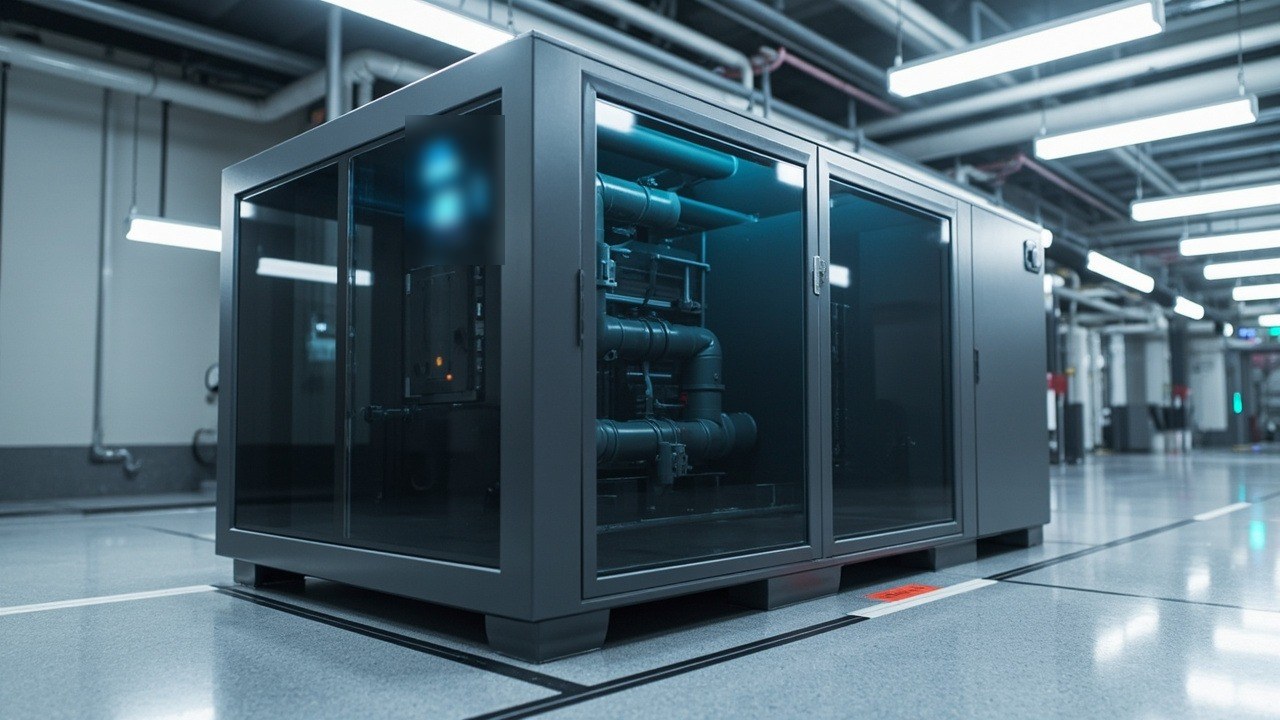
The CDU (Coolant Distribution Unit) connects the primary chilled water supply with the rack’s secondary loop as a central layer of hydraulic separation. The internal plate heat exchangers guarantee strict isolation of the media: the fluid in the IT loop never mixes with the building’s chilled water.
The reason is technical: central chilled water plants are designed for conventional air cooling, and that is why a high-performance CDU demands strict separation of hydraulic systems. That decoupling leaves the primary loop intact while the secondary side provides the flow rates, pressures and qualities that AI clusters demand.
A CDU is not quoted as "the chilled water box". It decides whether your primary network can keep operating with the parameters it was designed for, or whether every expansion forces you to resize the building’s plant. The comparison of CRAH, CRAC and in-row cooling covers the other end: how heat is dissipated without liquid.
The document presents a comparison of three schemes for 1,000 kW of cooling capacity:
| Scheme | TCS difference | FWS difference | Approach temperature | TCS pump power | Annual consumption |
|---|---|---|---|---|---|
| 4 K | 10 K | 10 K | 4 K | 13.7 kW | 235,539 kWh/a |
| 2 K | 10 K | 6 K | 2 K | 13.7 kW | 252,496 kWh/a |
| 2 K, two units | 10 K | 8 K | 2 K | 5.9 kW | 213,627 kWh/a |
The third row is the most counterintuitive: two 500 kW units (1,000 kW total) with 2 K approach temperature consume less than a single 1,000 kW unit at 4 K. By splitting the load, each pump works with less flow and consumption drops. N+1 design is not only an availability decision: it is also an electrical efficiency one. In Mexico, the difference between 235,539 and 213,627 kWh per year separates a project that holds up in an audit from one that doesn’t.
The efficiency lever is the approach temperature: going from 4 K down to 2 K is not a setpoint tweak, it is a design decision made at the start of the project. And if primary chilled water flow rates must be maintained for operational reasons — and in a brownfield they must — the system compensates for the additional load by resizing the heat exchanger area inside the CDU.
The three controls that decide whether your system survives a spike
A well-designed CDU is not a pump with a heat exchanger: it is a control system, and the control has three variables that address different problems.
Sustained inference at high load is an efficiency problem. Training is a spike problem.
For flow sizing there is an anchor value that planners use out of proven habit: approximately 1.5 liters per minute per kilowatt, sized close to maximum load peaks. The trap: the text is explicit that sizing this way can lead to a thermodynamically less efficient operating mode at the real partial load. It is a price paid on purpose, because it avoids any performance loss from heat. For an operations director: your liquid cooling is sized for the worst moment, not for the average. It is the same argument as the ROI of direct cooling versus immersion.
N+1 redundancy has its own mechanics. A master controller compares the sensors and runs a timed load rotation, with defined thresholds: if the active units have a valve opening or pump speed above 80% for at least ten minutes, or, conversely, a unit is switched off if that percentage falls below 40%. The standby can be cold, with even wear through rotation, or permanently warm.
The Mexican standard that applies to your modular design
There is a regulatory detail that international vendors would rather not mention and that in Mexico is enforceable: NOM-001-SEDE-2018 includes its own article for this modality: 646, "Modular Data Centers". The quoted text is the one the Secretaría de Energía submitted to public consultation and the Diario Oficial de la Federación published on August 6, 2018.
The article covers installed information technology equipment along with support, power supply and electrical distribution, wiring and protection, grounding, HVAC systems and similar. Its definition is operational: prefabricated units, of 1000 volts nominal or less, housing IT equipment cabinets, with a service entrance, UPS and an air or liquid cooling system.
There is a precedence condition that a project must read: when a discrepancy exists between the requirements of other articles of that Standard and what is established in Article 646, the requirements of Article 646 apply. The specific article prevails over the general rules.
For a Mexican integrator this has a practical consequence: when liquid cooling comes inside a modular data center — the format the market is pushing for prefabricated AI deployments — the entire electrical installation is evaluated against Article 646 and not only against the general framework. It is a verifiable argument before an inspector.
The five questions you must demand before the order is signed
All of the above comes down to five questions with a verifiable answer.
The CDU is not the box you add at the end of the cooling project: it is the hydraulic frontier that decides whether your primary loop survives the AI load, and the piece that costs you the most when it is sized wrong. In Mexico, with existing (brownfield) facilities that can rarely modify their chilled water temperatures, that decision becomes a problem of space and of budget.
Ask your vendor for the five numbers above in writing, with the formula and the assumptions, and compare them against the coolant volume you are actually going to install, not against the datasheet. If any answer is vague, the project is not ready to be quoted. To review on-site feasibility, request a technical assessment of your data center.
Sources
1. STULZ. «End-to-End Cooling: The Key to Resilient AI Data Centers» (technical paper) — https://www.stulz.com/newsroom/detail/end-to-end-cooling-the-key-to-resilient-ai-data-centers/
2. ASHRAE. «Energy and Thermal Efficiency | AI Data Center» (Technical Resources) — https://www.ashrae.org/technical-resources/topics-and-initiatives/ai-data-center/energy-and-thermal-efficiency
3. ASHRAE TC 9.9. «Water-Cooled Servers: Common Designs, Components, and Processes» — https://www.ashrae.org/file%20library/technical%20resources/bookstore/whitepaper_tc099-watercooledservers.pdf
Want to master this?
Noxtel Academy →