Secondary cooling: the chilled water loop that separates your cooling from the rack and why they audit it
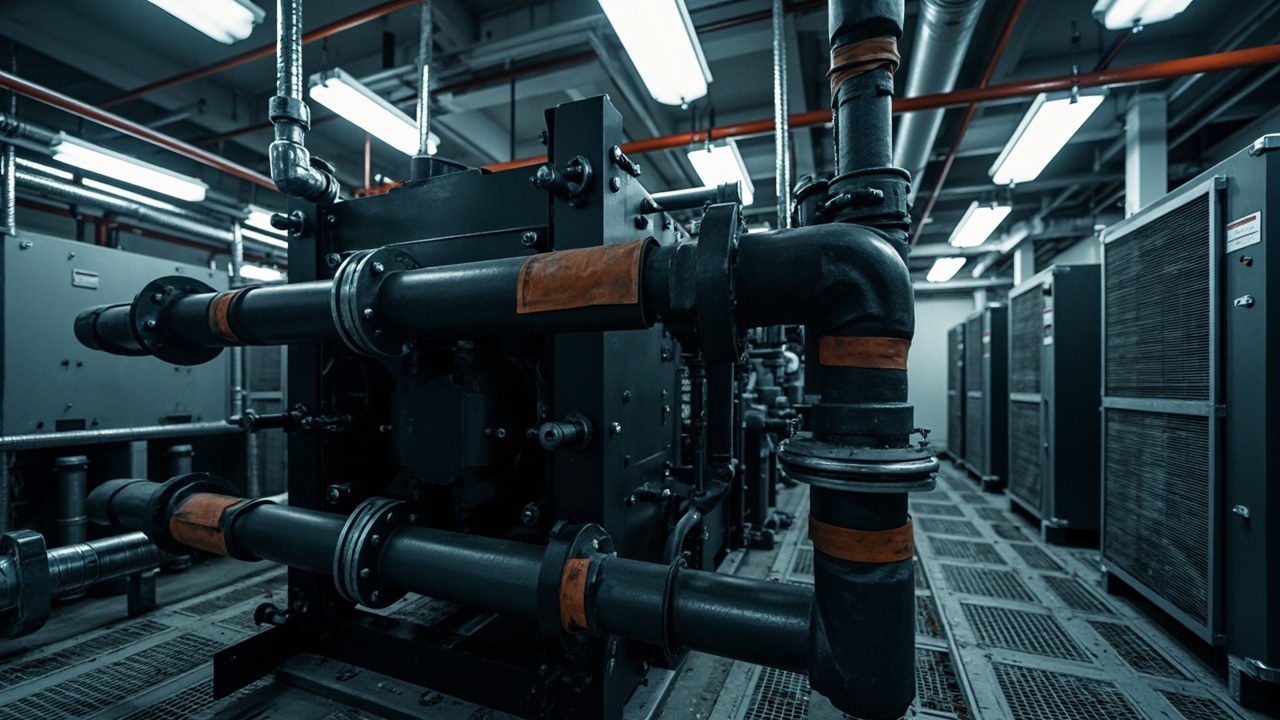
Your plant has two chilled water circuits and nobody has explained the difference to you. One moves the heat from the chillers to the units that cool the room. The other reaches all the way to the rack: that is the secondary loop, and it is the one an auditor will ask you about even if you have never seen it in a diagram.
What gets audited is not thermal performance. A well-designed secondary loop does not lower your PUE: it tells you whether you can swap a branch without draining the whole loop. It sounds like a maintenance detail, and that is where it decides how much downtime a pump failure costs you.
Two circuits, two waters, two tolerances
ASHRAE TC 9.9 splits the water into two domains. The facility water system, which feeds CRAH units, chillers and plant heat exchangers, tolerates a pH between 7 and 9, less than 1,000 CFU per milliliter of bacteria and less than 50 ppm of chlorides. The technology cooling system that reaches the cold plates is stricter: pH between 8.0 and 9.5, less than 100 CFU per milliliter, less than 5 ppm of chlorides and less than 20 ppm of hardness.
The reason is physical. The facility loop runs between 5 °C and 15 °C; the technology loop reaches 50 °C and 60 °C in W2 to W4 designs. The committee warns that materials that work well in the building may not work in the hot loop: corrosion is not the same problem at 12 °C as at 55 °C.
The 2 °C margin and the filter that is sized against the rack
The CDU must deliver the technology loop water above the room dew point, with a 2 °C margin. It is not comfort: it is the distance between the water and the temperature at which condensation would appear on the rack. That margin absorbs part of the uncertainty of the sensors.
Filtration is sized against the equipment, not against a market standard: TC 9.9 asks for an absolute rating between 7 and 10 times finer than the narrowest channel of the cold plate, with filters in N+1 or 2N and flow calculated with the filters dirty.
Why an auditor asks you about the loop
Because what gets audited is maintainability, not performance. In Tier III, Uptime Institute requires dry pipes: piping with no liquid flowing and not pressurized during joint and valve maintenance, so that a leak does not become an incident. In Tier IV it requires separating the chilled water and refrigerant piping into independent compartments outside the room. And there is one rule that hurts: if a single CDU cools more units than the redundant number of a row, the design is not not fault-tolerant.
And the practical rule applied on site is simple: the secondary loop is not audited to find out whether it cools better, but to find out whether you can intervene without affecting the rest of the room.
The Department of Energy says it is often more than you need
The criterion that decides between primary topology and primary with secondary, according to Uptime Institute, is the header pressure the chiller needs: a secondary loop with its own pumping station reaches it while avoiding 24-inch piping. But the U.S. Department of Energy and NREL best practices guide instructs the opposite: convert existing systems to primary only, and specify variable flow pumping with two-way valves on new builds.
The secondary layer is a capital premium and a pumping burden that is only justified by pressure, scale or independence between tenants. Uptime sets the trigger at 6 to 7 MW per loop, a multi-building campus and facilities of more than five floors.
In Mexico, altitude cuts your margin
ASHRAE TC 9.9 derates the maximum dry-bulb temperature by 1 °C for every 300 meters above 900 meters in classes A1, A2, B and C. Mexico City is at 2,240 meters: the recommended band for class A1, from 18 to 27 °C, drops to 14 to 23 °C and the permissible limit of 32 °C drops to 28 °C.
There is a second effect almost nobody quotes. The Department of Energy recommends raising the chilled water supply to 12.8 °C or higher, because it improves chiller efficiency. With that supply the economizer comes into play with an ambient wet-bulb below 12.8 °C for 3,000 hours a year and the 2 °C margin stops being decorative.
Your list for Monday morning
If you have a secondary loop, the useful audit has five questions and none of them is about PUE. Does the CDU have N+1 or 2N, and how many rows does each one feed? Was the filtration specified against the geometry of your cold plate or against a market standard? Is the rack water measured with periodic sampling, because bacteria is not measured online? Who owns the loop: facility or the IT group? How long does it take to drain a branch?
The second-to-last question is not rhetorical. TC 9.9 acknowledges that, because of the physical separation of the circuits, administration of the loop between facility and the IT group remains ambiguous. That is not resolved with a standard: it is resolved with a name on a document.
Sources
Want to master this?
Noxtel Academy →