How many trees must be planted to offset a data center: the math your ESG report evades
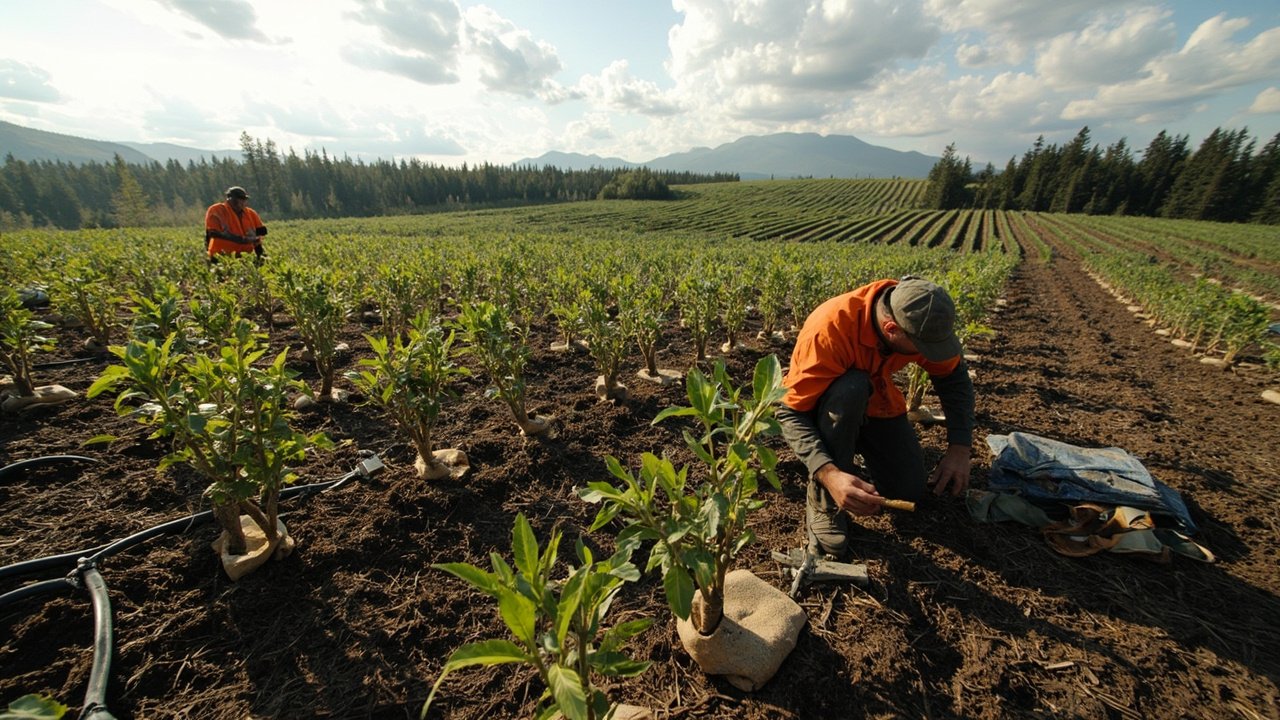
The 2024 sustainability report of a global hyperscale boasts of having offset 1.2 million tons of CO₂ through reforestation and equivalent projects. The number sounds impressive. The figure that is missing from the document is how many hectares of new forest are required to make that promise credible, and how long it really takes.
A newly planted urban tree sequesters, on average, 0.060 metric tons of CO₂ per year during its first 10 years, according to the EPA model used in the Greenhouse Gas Equivalencies Calculator [Source: EPA, Greenhouse Gas Equivalencies Calculator Calculations and References, epa.gov/energy]. Multiply that figure by the 10 years of monitored growth and an urban tree accumulates ~0.6 tons of CO₂. A new forest plantation, by contrast, can sequester between 0.67 and 50 metric tons of carbon per hectare per year depending on the species, the climate, and the age of the stand — a dispersion of nearly two orders of magnitude [Source: MIT Climate Portal, “How many new trees would we need to offset our carbon emissions”, climate.mit.edu].
The “tons offset” figure from an ESG report does not tell you whether the compensation is real removal or financial offset, nor what type of forest or region or in what time frame it takes place. The three questions the report evades.
The math you actually can do — and that few reports show
For a 10 MW Mexican data center with PUE 1.4, operating at 80% utilization and with a Mexican grid emission factor of ~0.45 tons of CO₂ per MWh [Source: SENER, Balance Nacional de Energía, national average electricity mix]:
- Annual electricity: 10 MW × 8,760 h × 0.80 × 1.4 PUE = 98,112 MWh/year.
- Direct operational emissions: 98,112 × 0.45 = 44,150 tons of CO₂ per year.
To offset 44,150 tons/year with urban trees at the EPA rate:
- 44,150 / 0.060 = ~735,800 trees planted per year and kept alive for 10 years.
But that is the optimistic count. The survival factor for urban trees drops from 68% to 59% between year 5 and year 10 [Source: EPA, cited above]. Applying an average survival rate of 64%, the number of trees you must plant and keep alive rises to ~1,150,000. And that assumes your afforestation uses urban tree seedlings; if you opt for a tropical forest plantation with a sequestration rate of 5 tons CO₂/ha/year, the number of hectares drops but the maintenance cost rises, and the biodiversity baseline changes.
What almost no ESG report publishes:
1. The calculation methodology for the “tree equivalent” (EPA urban tree vs. forest plantation vs. REDD+ avoided deforestation).
2. The assumed survival rate of the stand.
3. The start date and the “plateau” date when the stand stops sequestering because it matures.
4. Permanence — what happens if the stand burns or the land is sold.
The “tons offset” figure without those four pieces is marketing, not compensation.
Why “tree-planting” is not the most honest piece of an ESG plan
1. The kinetics of forest carbon are not linear. A young forest sequesters rapidly in the first 20 years, then stabilizes. A mature forest has stable carbon but stops removing net atmospheric CO₂. Compensation measured over 30 years is usually reported as the “annual average” extrapolated — which overestimates what the stand actually removes at the end of the period [Source: MIT Climate Portal].
2. Site quality matters more than tree count. One hectare of well-managed tropical forest can sequester 10 times more carbon than one hectare of a poorly irrigated plantation on degraded soil. Nurseries that sell “trees planted” as a metric do not distinguish between the two.
3. Permanence is not guaranteed. Forest fires in Mexico consumed more than 800,000 hectares in 2023-2024. If your compensation lives on susceptible forest land, your “removal” can reverse in a single season [Source: CONAFOR, Annual Forest Fire Report, 2024].
4. Additionality is difficult to prove. If you plant trees where they would have grown anyway (by natural succession or public programs), your “compensation” did not remove additional carbon. The Verified Carbon Standard (VCS) requires proof of additionality to issue credits.
5. Carbon credit accounting carries systemic risk. Verra, the leading global certifier, issued in 2023 a warning about overestimation of REDD+ credits — 30% of the credits issued between 2016-2020 turned out not to represent real removals [Source: independent analyses of the Verra registry, cited by Sylvera, 2024].
What a data center ESG report should include
If you are responsible for a data center that publishes an ESG report and you want the compensation section to be defensible:
1. Breakdown by method. How much goes to new afforestation, how much to avoided deforestation, how much to technological capture (DAC), how much to renewable energy purchase with additionality certificate. Each method has different kinetics, cost, and quality.
2. Baseline and additionality. What would have happened on that land without your project? If it was pastureland that would have stayed pastureland, planting trees is additional. If it was land in natural succession, it is not.
3. Documented permanence. Buffer pools, fire insurance, replacement mechanism if the project is lost. Verra requires a 20% buffer over the total credits issued.
4. Independent third-party verification. Not self-certification. Auditors such as SCS, TÜV, DNV. Named.
5. Tree traceability. GPS coordinates, species, planting date, verified survival at year 1, 3, 5, 10. Without that traceability, the “X trees planted” figure does not prove removal.
6. Comparison against on-site reduction. How much of your plan is real operational reduction (energy efficiency, lower PUE, direct contracted renewable energy) versus ex-post compensation? A data center that reduces its PUE from 1.6 to 1.3 avoids 18% of emissions at once — without planting a single tree. Compensating with efficiency is cheaper, faster, and more durable.
When “tree-planting” makes sense — and when it does not
It makes sense:
- As part of a watershed restoration program that benefits the local community where your data center operates.
- As marginal compensation for residual emissions after you have exhausted the possible operational reductions.
- As a piece of biodiversity offset where the local ecosystem needs reforestation for other reasons.
It does not make sense as the central piece:
- If your data center is connected to a carbon-intensive grid and you have not signed a renewable PPA.
- If your afforestation is far from your center of operations (another region, another country) without involving the local community.
- If the “compensation” represents more than 50% of your plan — that means you are not reducing real emissions.
The question your enterprise client will ask you
The questions in enterprise client RFPs in 2026 are no longer “is it ESG-compliant”. They are:
1. “What percentage of your electricity is under a direct renewable PPA, not offset?”>”
2. “What is your operational PUE, not the contractual one?”>”
3. “Your compensation is verified by whom, with what methodology, with what permanence buffer?”>”
4. “Are your credits real removal or avoided emission?”>”
If your answer is “we have a reforestation program that offsets 1.2 million tons”, the enterprise client will move on to the next question expecting hard numbers. If your answer is “we operate with 80% direct solar PPA since 2024, PUE 1.25, and our residual compensation is verified by SCS with a 25% buffer”, the client signs.
Tree-based compensation is the last 5% of a serious ESG plan, not the first. If your report puts it at the top, it evades the question that your enterprise client will ask you.
Sources
- US EPA — Greenhouse Gas Equivalencies Calculator: Calculations and References, epa.gov/energy, factor 0.060 tCO₂/urban tree/year
- MIT Climate Portal — How many new trees would we need to offset our carbon emissions, climate.mit.edu
- Sylvera — How Many Carbon Credits Per Tree, sylvera.com, analysis of additionality and permanence
- SENER — Balance Nacional de Energía, Mexican grid emission factor, national average ~0.45 tCO₂/MWh
- Verra Registry — Verified Carbon Standard, methodologies and buffer pools, verra.org
Want to master this?
Noxtel Academy →