
BESS replacing diesel generators in data centers: when it makes sense in Mexico (CFE + real ROI)
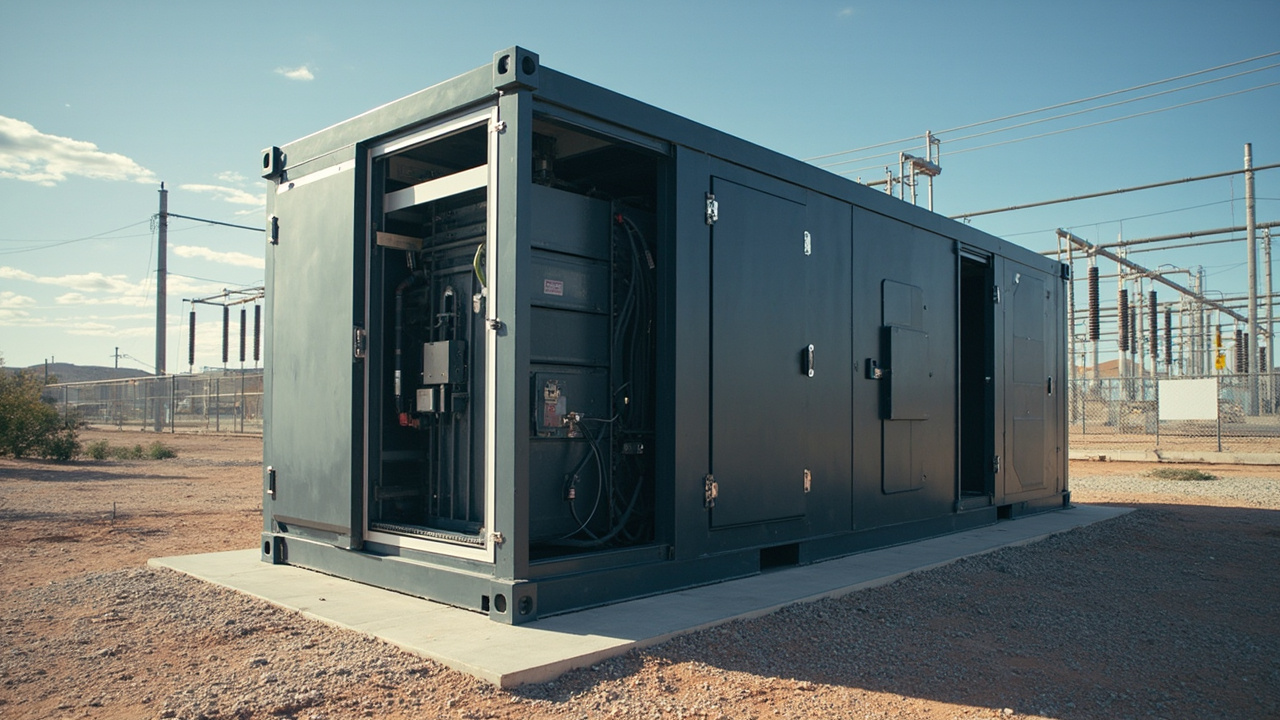
Over the past 24 months, Battery Energy Storage Systems (BESS) have shifted from a novelty to a real alternative to diesel generators in Tier III+ data centers in Mexico. Three reasons: (a) lithium battery prices dropped between 30% and 40% since 2023, (b) CFE medium-voltage tariffs (GDMTO, GDMTH) penalize peaks, and (c) diesel generators are losing regulatory exemptions (NOM-085, PROAIRE). This article breaks down when it makes sense, when it doesn’t, and how to evaluate the real ROI against CFE 2026.
What a BESS is in a data center (in 90 seconds)
A data center BESS is not an inflated cell phone battery. It is a system that combines lithium battery banks (LFP, lithium ferro-phosphate, not NMC) with bidirectional inverters (PCS), an energy management system (PMS/BMS) and, optionally, a grid connection to operate as UPS, emergency backup, solar energy storage, or tariff arbitrage.
In a Tier III+ data center, the BESS replaces one or two of the three traditional components of the power subsystem: the VRLA-battery UPS, the backup diesel generator, or both. The technical difference versus a VRLA UPS: the BESS has 4x higher energy density, cycles thousands of times (not just deep discharge), responds in milliseconds. The economic difference: it pays for itself in 6 to 8 years only if you use multiple functions (backup + peak shaving + CFE arbitrage). If it only replaces diesel, payback is over 10 years.
When it DOES make sense to replace the diesel generator with a BESS
The BESS makes sense in four scenarios. If you don’t fall into any of them, stick with diesel.
Scenario 1 — CFE demand greater than 2 MVA and GDMTO tariff
Under GDMTO (Gran Demanda Mayor a 100 kW) or GDMTH (media tensión horaria) tariff, the demand charge in MXN per kW can represent between 40% and 55% of the monthly bill. A BESS that shaves 200 kW of peak for 2 hours/day reduces the demand charge proportionally and pays back in 4 to 6 years just on peak shaving, before any other function.
Scenario 2 — Data center in a metropolitan area with diesel restrictions (NOM-085)
NOM-085-SEMARNAT-2011 limits emissions from diesel generators in metropolitan areas. In CDMX, Guadalajara and Monterrey, hourly diesel operation during environmental contingencies is restricted, and PROAIRE activation can require generator shutdown for 6 to 12 hours. A BESS eliminates this exposure and keeps the DC online during the window.
Scenario 3 — Coupling with on-site solar generation (BESS + PV combination)
With a distributed generation contract with CFE and 1 MVA or more of photovoltaic capacity on site, the BESS becomes the buffer that lets you store daytime PV generation and discharge it during the evening peak. The combined ROI (PV + BESS + arbitrage) reaches payback in 5 to 7 years; PV alone has 7 to 10 years, BESS alone has 9 to 12 years.
Scenario 4 — 24/7 operation with Tier IV SLA (≥ 99.995%)
With a Tier IV SLA (99.995% uptime, less than 26 minutes per year) and recurring peaks, the BESS gives you sub-second transfer between grid and battery, vs 10 to 15 seconds with a diesel generator. That difference is what lets you meet Tier IV; diesel alone does not.
When it does NOT make sense: the 4 traps
The BESS is not for every project. Four common cases where the reasonable decision is to stay with the diesel generator.
Trap 1 — Tier II project under OM (Ordinaria) tariff
Four common cases where the reasonable decision is to stay with the diesel generator. If your site is Tier II (99.741% uptime, less than 22 hours/year) and your CFE tariff is OM (Ordinaria, less than 100 kW), the demand charge does not justify a BESS. A correctly sized diesel generator covers your contingency in 30 seconds and you save on CAPEX.
Trap 2 — No reliable grid backup
Trap 2. If your site has more than 8 CFE outages per year (rural areas of Hidalgo, Chiapas, Oaxaca, Sinaloa), the BESS without grid backup leaves you exposed to a discharge of 2 to 4 hours; then you’re out. A diesel generator with a 24-hour fuel tank is still the right call.
Trap 3 — Site with unstable variable load (speculative data center)
Trap 3. If you’re building a speculative data center (no signed tenant contracts), the BESS size has to assume worst-case load, which inflates CAPEX 40% to 60%. Better to start with diesel and migrate to BESS in phase 2 once you have real load curves.
Trap 4 — Buying the BESS without thermal sizing
BESS in hot climates needs redundant HVAC to keep cells between 20°C and 35°C. Above 40°C, LFP cells lose 30% of their cycle life. A BESS without redundant cooling fails in 4 years instead of lasting 12. This is the most expensive trap because it shows up after commissioning.
How to evaluate real ROI with CFE (the 3 formulas that matter)
The calculation depends on three numbers from your CFE tariff.
Formula 1 — Demand charge avoided (peak shaving)
Demand savings = (Peak demand without BESS minus Peak demand with BESS) times Demand tariff ($/kW-month) times 12 months. In GDMTO with peak shaving of 200 kW at MXN $450/kW-month, that’s MXN $1,080,000 per year of direct savings.
Formula 2 — Energy arbitrage (valley charge / peak discharge cycle)
Arbitrage savings = Daily energy (kWh) times (Peak tariff minus Valley tariff) times 365. In GDMTO with a spread of MXN $1.20/kWh between peak and valley, and 1 MWh daily cycling, that’s MXN $438,000 per year.
Formula 3 — SLA penalty avoided (if applicable)
With a Tier IV SLA penalizing unavailability at 1% of the charge for every 0.1% over the agreed uptime, a single avoided 4-hour outage pays back between MXN $800,000 and MXN $3,500,000 depending on the contracted DC capacity. One avoided incident per year justifies the BESS.
Why international vendors lie to you with the numbers
Three patterns that inflate ROI in Mexico.
Pattern 1. They quote assuming 25°C ambient. Mexico has areas with 38°C for 6 or more months. At those temperatures, the BESS degrades 25% faster and capacity drops 15%. The “15-year life” becomes 11 years effective.
Pattern 2. They assume grid injection. In Mexico, distributed storage regulation does not yet allow net injection to the CFE grid in most zones. If the contract assumes injection, ROI is overestimated by 30% to 40%.
Pattern 3. They calculate payback with declared useful life (10 to 15 years). LFP cells in real Mexican conditions (heat + cycling + DOD 80%) give 8 to 11 years. The 4-year difference materially shifts the payback.
Conclusion: when to sign and when to wait
Sign the BESS if three answers are affirmative: (1) CFE tariff is GDMTO or GDMTH with demand greater than 1 MVA, (2) the site has solar PV or contracts a hybrid renewable expansion in the next 24 months, and (3) the SLA with your clients is Tier III+ with concrete downtime penalties. If any of the three is negative, stay with diesel for now and revisit in 12 to 18 months.
Sources
- EPRI (Electric Power Research Institute): energy storage programs for data centers — https://www.epri.com/research/programs/168023
- Uptime Institute: BESS vs diesel generator analysis in data centers — https://www.uptimeinstitute.com/blog/bess-vs-dc-data-center
- ANSI/TIA: applicable standards (TIA-942-B-2023, ANSI/TIA-568) — https://www.tiaonline.org/
- Sandia National Laboratories: Energy Storage Systems program (battery test standard) — https://www.sandia.gov/ess-ssl/
- CENACE (Mexico): Wholesale energy market and tariffs for qualified users — https://www.cenace.gob.mx/Paginas/publicaciones/Mercado%20de%20Energ%C3%ADa.aspx
Want to master this topic?
Noxtel Academy →Want to master this?
Noxtel Academy →
